

A Holistic Approach to Achieving SDG1
Poverty is one of the most pressing challenges facing humanity today. Despite significant progress over the past few decades, millions of people around the world still live in extreme poverty, struggling to meet their basic needs. The United Nations’ Sustainable Development Goal 1 (SDG1) aims to “end poverty in all its forms everywhere” by 2030. Achieving this vastly ambitious goal requires a comprehensive, multi-faceted approach that addresses the root causes of poverty and leverages the collective efforts of governments, private sectors, NGOs and local communities.
In this article, we will explore the key strategies, challenges, and opportunities in the fight to end poverty everywhere, drawing insights from the document “Ending Poverty Everywhere – SDG1” – this document is an example of one of many reports from PreEmpt.Life, and is free-of-charge to download. We will also discuss how innovative solutions, such as those offered by PreEmpt.Life, can play a crucial role in driving this global effort.
The Multi-Dimensional Nature of Poverty
Poverty is not just a lack of income; it is a complex, multi-dimensional issue that encompasses social, economic, cultural, and environmental factors. To effectively address poverty, we must move beyond traditional economic measures and adopt a holistic approach that considers the unique challenges faced by different communities.
Global Poverty Statistics and Trends Over the Last 50 Years
To understand the progress made and the challenges that remain, let’s look at some key statistics and trends in global poverty over the last 50 years, sourced from authoritative organizations: World Bank, United Nations, and International Monetary Fund (IMF).
Global Poverty Rates
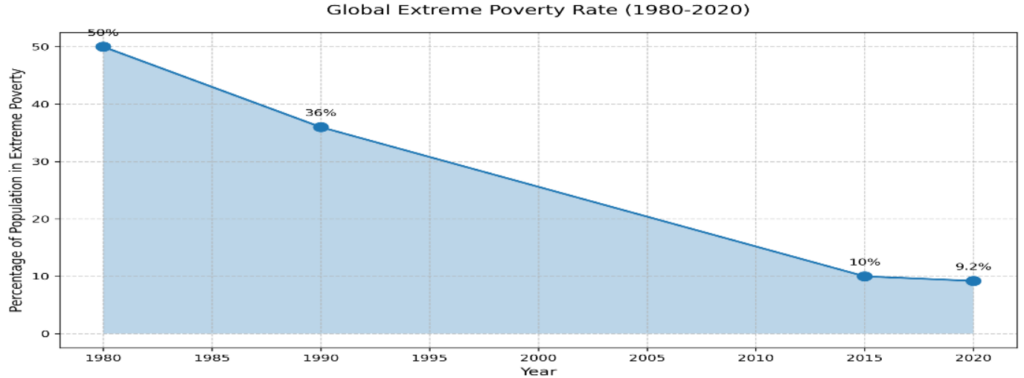
- 1970s-1980s: In the 1970s and 1980s, global poverty rates were extremely high, with more than half of the world’s population living in extreme poverty (defined as living on less than $1.90 per day in 2011 purchasing power parity terms).
- 1990: According to the World Bank, in 1990, 36% of the global population lived in extreme poverty, amounting to approximately 1.9 billion people.
- 2015: By 2015, the global extreme poverty rate had dropped to 10%, representing about 734 million people.
- 2020: The COVID-19 pandemic caused a significant setback, with the World Bank estimating that the global poverty rate increased to around 9.2% in 2020, pushing an additional 88 million people into extreme poverty.
Regional Poverty Trends
- East Asia and the Pacific: This region has seen the most dramatic reduction in poverty. In 1990, 60% of the population lived in extreme poverty, but by 2015, this figure had dropped to just 3.5%. China’s rapid economic growth played a significant role in this decline.
- South Asia: Poverty in South Asia has also decreased significantly, from 45% in 1990 to 12.4% in 2015. India, in particular, has made substantial progress, although challenges remain in rural areas.
- Sub-Saharan Africa: This region has seen slower progress. In 1990, 54% of the population lived in extreme poverty, and by 2015, this figure had only decreased to 41%. Sub-Saharan Africa remains the region with the highest concentration of extreme poverty.
- Latin America and the Caribbean: Poverty rates in this region have fluctuated but generally declined from 14% in 1990 to 4% in 2015. However, economic instability and inequality continue to pose challenges.
Impact of Economic Growth and Inequality
- Economic Growth: Economic growth has been a major driver of poverty reduction. Countries that experienced sustained economic growth, such as China and India, have seen significant declines in poverty rates.
- Inequality: Despite overall progress, inequality remains a significant barrier. In many regions, the benefits of economic growth have not been evenly distributed, leading to persistent poverty among marginalized groups.
Impact of Global Initiatives
- Millennium Development Goals (MDGs): The MDGs, established in 2000, set a target to halve extreme poverty by 2015. This goal was met ahead of schedule, with the global poverty rate dropping from 36% in 1990 to 10% in 2015.
- Sustainable Development Goals (SDGs): The SDGs, adopted in 2015, aim to eradicate extreme poverty entirely by 2030. While progress has been made, the COVID-19 pandemic has highlighted the fragility of these gains and the need for continued effort.
Future Projections
- Post-COVID-19 Recovery: The World Bank projects that global poverty rates will continue to decline, but the pace of reduction will depend on the effectiveness of post-pandemic recovery efforts.
- Climate Change: Climate change poses a significant threat to poverty reduction, particularly in vulnerable regions. Addressing climate-related challenges will be crucial for sustaining progress.
Key Dimensions of Poverty
- Economic Poverty: Lack of income and resources to meet basic needs such as food, shelter, and healthcare.
- Social Poverty: Exclusion from social networks, education, and opportunities for personal development.
- Cultural Poverty: Marginalization of certain groups based on cultural, ethnic or religious identities.
- Environmental Poverty: Vulnerability to environmental degradation, climate change and natural disasters.
Understanding these dimensions is crucial for designing targeted interventions that address the specific needs of different populations.
A Comprehensive Strategy to End Poverty
The document “Ending Poverty Everywhere – SDG1 (Reasoning)” outlines a comprehensive strategy for eradicating poverty, guided by principles of empathy, innovation, sustainability, equity and solidarity. Here are some of the key components of this strategy:
Empower Communities
Empowering local communities is at the heart of any effective poverty alleviation strategy. By involving communities in the design and implementation of poverty reduction programs, we can ensure that solutions are tailored to local needs and contexts. This approach fosters a sense of ownership and accountability, leading to more sustainable outcomes.
Key Actions:
- Capacity Building: Provide training and resources to help communities develop the skills and knowledge needed to improve their livelihoods.
- Access to Resources: Ensure that communities have access to essential resources such as clean water, healthcare, education, and financial services.
- Community-Led Solutions: Encourage local innovation and problem-solving by supporting community-driven initiatives.
Leverage Technology
Technology has the potential to revolutionize poverty alleviation efforts by enhancing decision-making, improving resource allocation, and enabling more efficient service delivery. From AI-powered data analytics to mobile banking platforms, technology can empower individuals and communities to break the cycle of poverty. Services and tools such as PreEmpt.Life can build a multiple choice of scenarios and actionable steps that can be tailored to individual countries needs and resources.
Key Actions:
- AI and Big Data: Use advanced data analytics to identify poverty hotspots, track progress, and optimize resource allocation.
- Digital Platforms: Develop digital platforms that facilitate knowledge sharing, financial inclusion, and access to essential services.
- Ethical AI: Ensure that AI technologies are developed and deployed in a way that promotes equity and inclusivity.
Foster Global Solidarity
Ending poverty requires a collective effort that ignores national borders. By fostering global solidarity, we can mobilize the resources, expertise and the political will needed to tackle poverty on a global scale.
Key Actions:
- Global Fund for Poverty Alleviation: Establish a global fund that prioritizes the most vulnerable and marginalized communities. many charities and funds are already available, but coordination between them is fragmentary.
- International Collaboration: Promote partnerships between governments, NGOs, private sectors and local communities to share best practices and coordinate efforts.
- Advocacy and Awareness: Raise awareness about the importance of poverty eradication and advocate for policy changes that support this goal.
Promote Regenerative Economies
A shift towards regenerative, circular economies can help address the root causes of poverty by promoting sustainability, resilience, and self-sufficiency. By aligning economic activities with ecological principles, we can create a more equitable and sustainable world.
Key Actions:
- Circular Economy Models: Promote economic models that minimize waste, optimize resource use, and create value from by-products.
- Local Self-Sufficiency: Support local economies by encouraging the production and consumption of locally sourced goods and services.
- Sustainable Practices: Encourage businesses and communities to adopt sustainable practices that protect the environment and promote long-term prosperity.
Overcoming Challenges in Poverty Eradication
While the strategies outlined above offer a promising path towards ending poverty, several challenges must be addressed to ensure their success.
- Resource Constraints
Limited financial and human resources can hinder the implementation of poverty alleviation programs. To overcome this challenge, it is essential to mobilize resources from multiple sources, including governments, private sectors, and international organizations.
- Regional Disparities
Poverty rates and challenges vary significantly across regions, requiring tailored solutions that address local contexts. A one-size-fits-all approach is unlikely to be effective, and efforts must be made to ensure that interventions are context-specific.
- Resistance to Change
Powerful entities that benefit from the status quo may resist efforts to address poverty. Overcoming this resistance requires strong leadership, advocacy, and the involvement of all stakeholders in the decision-making process.
- Measuring Success
Traditional economic indicators, such as GDP, are insufficient for measuring the success of poverty alleviation efforts. A more comprehensive set of indicators that consider social, environmental, and cultural factors is needed to track progress and ensure accountability.
The Role of PreEmpt.Life in Ending Poverty
At PreEmpt.Life, we believe that decision intelligence, strategic foresight, and horizon-scanning are essential tools for addressing complex global challenges like poverty. Our AI-assisted disruptive services empower organizations to make informed, data-driven decisions that drive positive change by delivering actionable choices with individual steps.
How PreEmpt.Life Can Help:
- Strategic Foresight: Our horizon-scanning services help organizations anticipate future trends and challenges, enabling them to develop proactive strategies for poverty alleviation.
- Decision Intelligence: By leveraging AI and big data, we provide actionable insights that enhance decision-making and optimize resource allocation.
- Collaborative Solutions: We investigate and facilitate potential partnerships between governments, NGOs, private sectors and local communities, to foster global solidarity and collective action.
The Next Steps
Ending poverty everywhere is a monumental task, but it is one that we must undertake with urgency and determination. By adopting a holistic, multi-dimensional approach that empowers communities, leverages technology, fosters global solidarity, and promotes regenerative economies, we can create a world where everyone has the opportunity to thrive.
At PreEmpt.Life, we are committed to leading the charge in this global effort. Our decision intelligence, strategic foresight and horizon-scanning services are designed to help organizations navigate the complexities of poverty eradication and drive impactful change.
Ready to take the next step in ending poverty? Partner with PreEmpt.Life to harness the power of decision intelligence and strategic foresight. Together, we can build a future where poverty is a thing of the past. Contact us today to learn more about our services and how we can support your mission.
By working together, we can turn the vision of a poverty-free world into reality. Let’s take the first step together today.